
What Is an Apostille? (And How to Know If You Actually Need One)
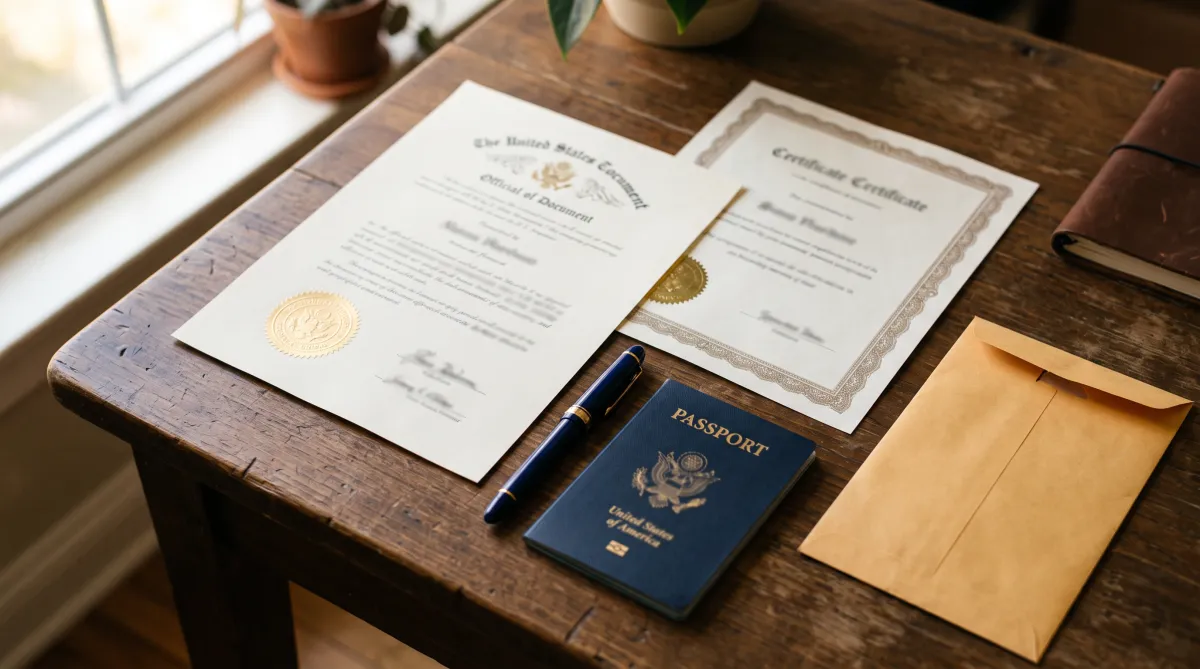
An apostille is a government certificate that authenticates the origin of a public document for use abroad. It does not validate the document's contents. If someone abroad — a consulate, a university, an employer, a court — has asked you for an "apostilled" document, this is what they mean.
Most people encounter apostilles exactly once, under a deadline, with no idea where to start. This guide covers what an apostille actually is, which documents qualify, how the process works, and where it usually goes wrong.
What is an apostille, in plain English?
When you hand a U.S. birth certificate to an official in Spain, they have no way to know whether it's real. They don't recognize your county clerk's signature. They can't verify your state's seal.
The apostille solves that. It is issued by a designated government authority, such as a state Secretary of State or the U.S. Department of State for eligible federal documents. It certifies the signature, the signer's official role, and any seal or stamp on the document.
The Convention provides a standard certificate model, although its presentation and verification method can differ by issuing authority. Officials in other Convention countries can recognize it without having to understand American recordkeeping.
Apostille vs. authentication: which one do you need?
This depends entirely on the destination country.
The Convention has over 125 Contracting Parties. When both the issuing country and destination are covered, an apostille generally replaces consular legalization. The receiving organization can still set document, translation, or timing requirements.
If the destination isnotcovered by the Convention, the document may need authentication or legalization instead. The exact chain varies by the document, the issuing authority, and the destination country's rules.
Requirements vary by document, issuing authority, destination country, and receiving organization. Confirming the destination and the recipient's instructions first is the most useful thing you can do before starting.
Which documents can be apostilled?
Two broad categories qualify.
Vital and government-issued records, including:
Birth, marriage, and death certificates
Divorce decrees and name change orders
Naturalization certificates
FBI background checks
Certificates of no impediment (for marrying abroad)
Police reports
IRS letters and Social Security benefit letters
Court documents
Private documents that have been notarized first, including:
Powers of attorney
Corporate records, articles of incorporation, and board resolutions
Diplomas, transcripts, and academic records
Passport and driver's license copies
Affidavits and personal declarations
The distinction matters. A certified birth certificate is usually handled by the competent authority for the state that issued it, although some official signatures require an extra county-level certification first. A power of attorney generally has to be notarizedbeforeit can be apostilled, and the state must be able to authenticate the notary's signature.
How the apostille process works, step by step
Confirm the destination country and the exact requirement. Ask whoever requested the document: apostille or embassy legalization? Do they need the original or a certified copy? Do they need a translation?
Get the right version of the document. Many apostille requests fail here. Ordinary photocopies are often not accepted, although a properly notarized or certified copy may work for some document types. Hospital-issued "souvenir" birth certificates are not certified vital records; request an eligible certified copy from the appropriate county or state office.
Notarize, if it's a private document. The notary's commission has to be current and correctly recorded, or the state will reject it.
Submit to the correct authority. State documents generally go to the competent authority in the state that issued them. Eligible federal documents, including FBI background checks, generally go to the U.S. Department of State. Check agency-specific instructions before submitting other federal records.
Add embassy legalization if required. Only for non-Hague countries.
Ship it. International courier with tracking, in most cases.
How long does an apostille take?
Processing time depends on the issuing authority, document type, submission method, and whether authentication or embassy legalization is also required. Published estimates can change, so verify current timing with each authority involved.
If you're working against a deadline, share it before starting. Notary Pin can identify the required steps and available options, but government and embassy processing times are outside our control.
Where apostille requests usually go wrong
Wrong document version. Using an ordinary copy when a certified original is required is a common rejection reason.
Wrong authority. Sending a federal document to a state office, or vice versa, can delay the request.
Bad notarization. Missing venue, wrong certificate wording, expired commission.
Assuming apostille is enough.If the destination is not covered by the Convention, the receiving organization may require a different legalization chain.
Missing translation.Translation and notarization requirements vary by destination and receiving organization, so confirm the required sequence before submitting.
Frequently asked questions
Does an apostille expire?
The apostille itself generally does not carry an expiration date. However, a receiving organization may require the underlying document or apostille to be recent, so confirm its rules before ordering new records.
Can I apostille a document from a different state?
Yes, but it has to go through the state that issued it. A Texas birth certificate gets its apostille from Texas, regardless of where you live now.
Can I apostille a photocopy?
Generally no for vital records. For some documents, a notarized certified copy works — but this varies by state and by what the receiving country will accept.
Do I need to be present?
Usually not for the apostille submission itself. If the document needs an in-person notarization first, the signer must appear before the notary; a mobile notary can come to the signer.
Get your apostille handled start to finish
Notary Pin coordinates the process nationwide: notarization where needed, submission to the appropriate state or federal authority, embassy legalization for non-Hague destinations, and tracked international shipping when requested.
Send us the document type and destination country and we'll explain the expected steps, current estimated timing, and price before you commit.